

CHINA COURT
The Silk Routes linked the Orient and the Occident since early times. During Ibn Battuta’s era, Chinese ports were the most significant long-distance Muslim trade destinations. Arab trade with China was boosted when the Mongol Yuan Dynasty took China in 1279. The Yuan’s open-door policies led to the employment of Muslims of all origins within their bureaucracy. Muslim travellers knew that they could find hospitality in all the major seaports along the Chinese coast.
When Ibn Battuta was in India, Sultan Tuguluq offered him the opportunity of being ambassador to China. The Sultan, however, was an erratic person by nature and Ibn Battuta came frequently under suspicion for a variety of reasons. This new occupation gave him the chance to get away from the Sultan while at the same time explore the wonders of China.
Getting there proved difficult though. En route, he and his party were attacked by Hindu rebels. He was robbed and nearly lost his life. Several of the ships in his expedition were sunk by storms and he was attacked by pirates. Finally he made it to Quanzhou in the Fujian Province. He admired much that he saw: beautiful silks and the finest porcelain pottery. He was also introduced to the use of paper money and had high admiration for the artistic skills of the Chinese people. He travelled as far north as Hangzhou, not far from modern day Shanghai.
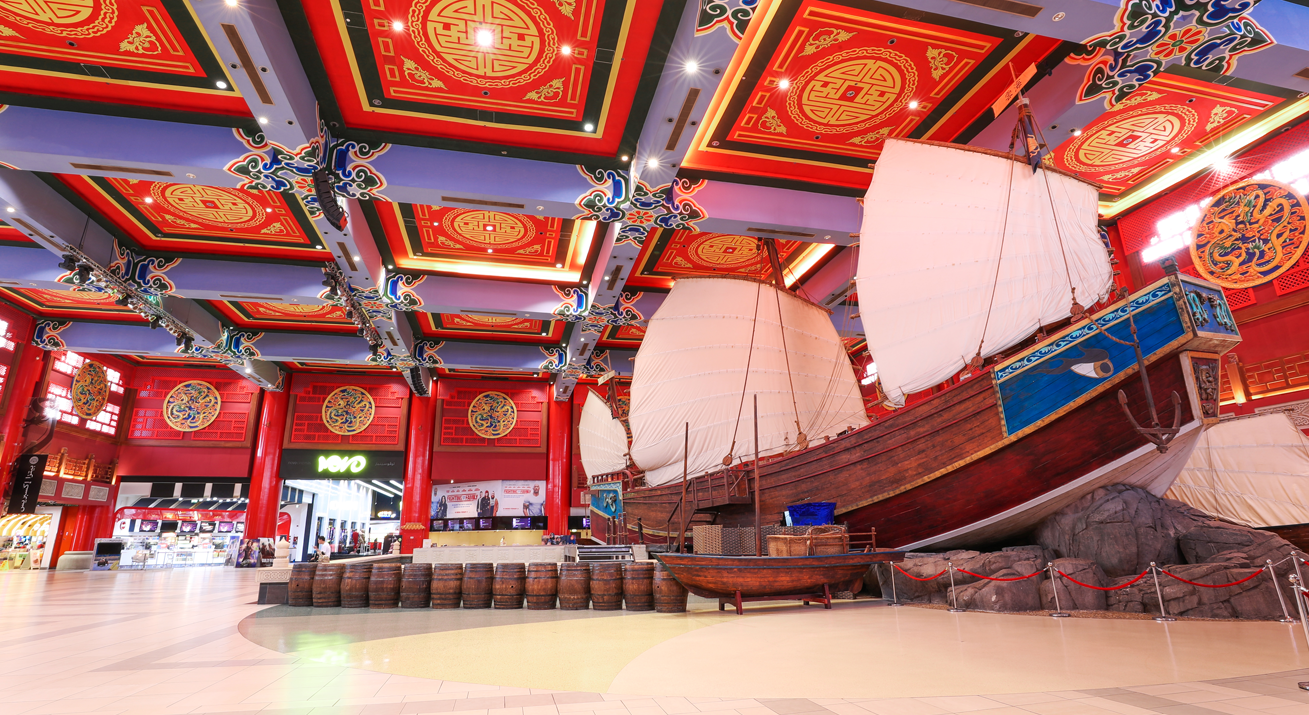
China Court is a kaleidoscope of colours and stylistic designs. Every available space is decorated with gold trimmings, floral patterns, dragons and phoenixes. Roofs are supported by intricate rafters and rest on colossal red lacquered columns. Like the temples and palaces of China, the spaces are large and extravagant.
Entrance Corridor and Forecourt
The Entrance Corridor, that leads up to the Main Court, features multi-tiered white marble beams carved with intricate floral designs and reminds one of the enigmatic stone gates of ancient China. The columns supporting these structures display Chinese proverbs with old wise sayings. The coffered ceiling has stylistic floral motifs and is based on the ceiling of the “Temple of the Five Immortals” in Guangzhou.
The next section displays panels decorated with gilded phoenixes and dragons. In Chinese culture these are the principal motifs used for royalty and when used together they symbolize happiness. The “Temple of Heaven” in Beijing provided the main inspiration for the use of these motifs.
Minor Court
Here the “Temple of Heaven” in Beijing was used as reference and this is evident in the elaborate ceiling structure. This consists of is a series of four-part brackets, which in turn are supported by other clusters of brackets set on the columns. These brackets are painted with vibrant colours and are a classic example of Chinese roof design.
Below, a series of red and gold panels, based on similar ones at the Chaotian Palace in China, complete the design.
Of all the coffered ceilings in China Court, the one in this court is indeed the most spectacular and reminds one of those found at the gates of the Forbidden City in Beijing.
Towards the entrance to the next court, there are two typical pavilion-like “gates” featuring characteristic overhanging roofs with upturned eaves – the hallmark of Chinese architecture. These structures are constructed in the traditional Chinese way and with wood imported from China. The glazed roof tiles are also authentic.
Main Court
The Main Court is a huge colonnaded hall based on typical elements found at so many of those famous buildings at the Forbidden City in Beijing. The Chinese principal of balance and symmetry was followed. Red, which in China is the symbol of good fortune and wealth, is the dominant colour. The huge lacquered columns give the Court an imposing quality befitting a Chinese Emperor.
Between each column is a huge medallion displaying a dragon in brilliant colours. These medallions were inspired by the designs found on a Chinese drum in Beijing’s famous Drum Tower. Gilded balustrades with typical Chinese lattice-designs fill the balcony space below. Coffered ceilings are a common feature in the palaces and temples of China and here they display stylistic Chinese motifs.
Exterior
The Forbidden City and the Chaotian Palace in China were the inspiration for the exterior design of China Court. This can be seen in the colossal entrance-gate (compare the “Shenwu Gate” – Forbidden City) and in the colonnaded verandas. The roof structure of the veranda resembles the typical glazed ceramic tile roofs of China with their overhanging caves distinguished by a graceful upward slope.The balustrades between the columns feature Chinese lattice-designs and the wall spaces behind have panels resembling doors or window panels found at the Chaotian Palace.
CHINESE JUNK
The most exciting feature in the Main Court is a huge Chinese Junk. A Junk is a native sailing vessel common to the Far East and the Chinese developed it into one of the strongest and most seaworthy vessels in medieval times. It is a flat bottomed, high-sterned vessel with a square bow and carries three masts using lugsails often made from linen or matting stiffened with horizontal battens. Junks were trading ships, but for many years they were also used as the general warship of the Chinese.
Ibn Battuta sailed on one of these ships to China.
Chinese Junks were highly decorated. The stern featured traditional symbols for the vessel’s welfare. In Chinese mythology, the Phoenix is the “mother” of the Dragon and represents new life. The Dragon represents strength and courage, while the snake symbolizes cunning and resourcefulness. The Junks were also adorned with two eyes at the bow to assist with navigation.
To fully appreciate the iconic symbol of the Junk Ship, the exhibit in the Main Court also tells the story of the greatest navigator of the Far East: Zheng He. He was the Admiral of the Chinese Fleet in the late 14th and early 15th centuries. With his impressive Junk ships, he would cross oceans to East Africa, Mecca, the Persian Gulf and throughout the Indian Ocean. His ships were by far the most impressive in history. Each ship had nine masts and was manned by 500 people.
The exhibit also displays three Sampans. These were mainly fishing boats used in the harbours or rivers of China since ancient times. Ibn Battuta must have come across many of these during his travels.