

PERSIA COURT

The Mongol Invasion under Genghis Khan in the 13th century laid waist to many of the great cities of Persia. When Baghdad was captured the Abbasid Caliphate rule came to an end. The new conquerors set up their own governments in Persia and trade resumed while new towns were built. Eventually the Mongols converted to Islam and Ghazan was the first ruler to make Islam the state religion (1295 – 1304). The rulers became patrons of Persian culture. Large sums were paid to promote refined craft and learning and architectural projects flourished.

Ibn Battuta arrived in Persia in 1326 from Mecca after he joined a caravan of pilgrims. In al-Najaf he visited holy sites and met with Sufi Muslims. The next stop was Basra from where he took a small sailboat up river to the city of Abadan. In Isfahan (the Orchard City), he lodged at a Sufi center and met with religious and legal scholars. Barsian, the next stop, had a Seljuk mosque with a Caravasarais. These buildings were often attached to mosques and were built to encourage international trade.  Shiraz (Garden City) was a refuge for many well educated Muslims who fled the Mongol invasion in the past. As a result it led to a cultural flowering of literature and art. It had beautiful bazaars, fruit gardens and rivers.
Baghdad was once the capital of the Abbasid Empire, but many of the buildings were destroyed by the Mongol invasion. Here, Ibn Battuta met the ruler Abu Sa’id, the Il-Khan.
The last stop was Tabriz, one of the most important cities in Persia and the first capital of the Il-Khans. This city had become an important place along the Silk Road and was one of the greatest centers of learning and culture during the 14th century.

Originally, Persia was dominated by Abbasid architecture where brick was the main building material. A variety of vaulting techniques were developed and the pointed arch was extensively used. Ornamental panels were made from wood and stucco, while geometric motifs became so abstract that their designs consisted only of positive and negative visual spaces. Monumental arched entrances were common features on mosques and madrasas.

The invasion of Central Asian Turks led to the introduction of large pointed domes that dominated the outer facades of buildings. Complex brick patterning in a variety of geometric designs also started to appear on buildings.

Considerable refinement in architectural decoration occurred under the Mongols, including a greater use of colour. This was achieved by the use of glazed tile mosaics and the emphasis was on surface rather than structure.


Minor Court

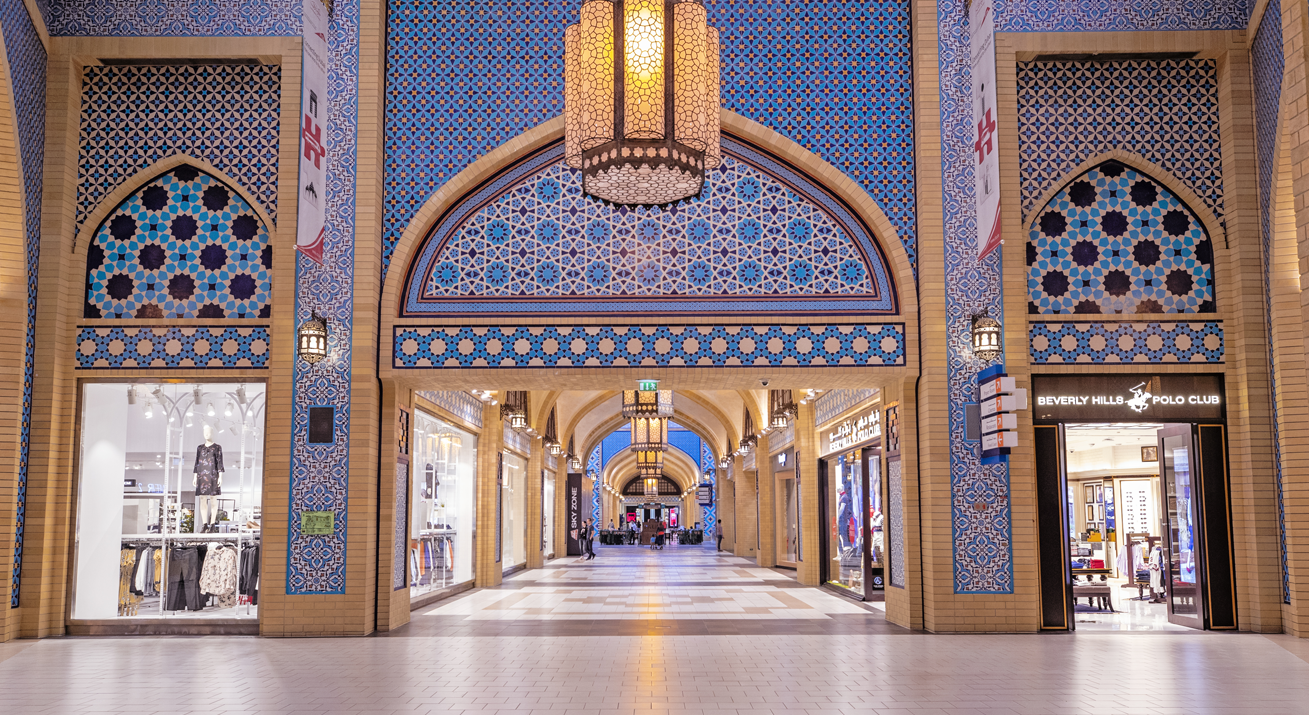
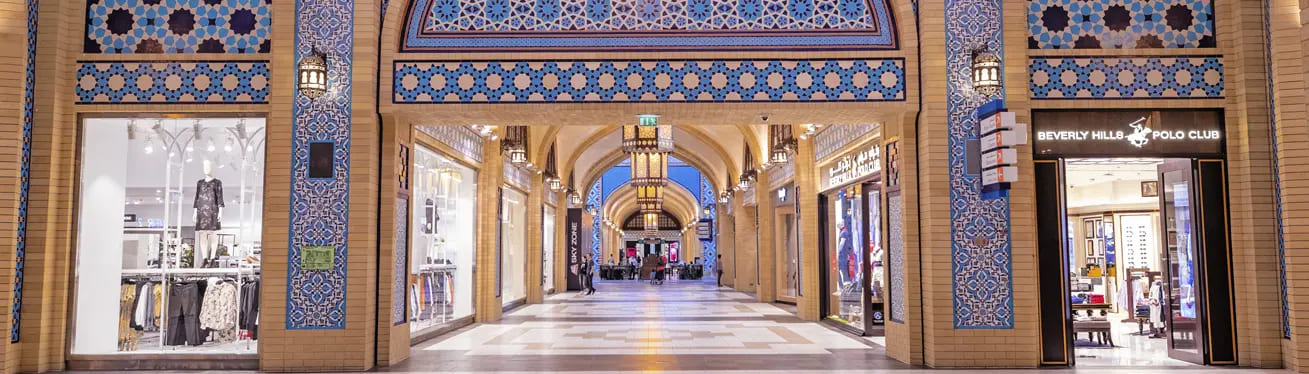
Entering Persia Court from the outside, one finds oneself immediately in one of the vaulted streets of a bazaar in the heart of Baghdad. The bazaar is one of the classic defining features of an Islamic town. This market-like environment was achieved by the use of cross-vaulted ceilings separated by glazed brick arches. Huge, arched wooden windows provide natural lighting and colourful mosaics, made from glazed tiles with abstract and arabesque designs, decorate the wall spaces. The brass lanterns are typical of the ones found in madrasas and mosques of Iran and Iraq.

The next space utilizes the same elements, but this time they are elevated and crowned by a magnificent wooden ceiling. Wood was an integral part of buildings in Islamic architecture and patterned ceilings like this one are popular in palaces and mosques. Islam transformed geometry into a major art form, using the circle as the basis for the generation of patterns and applying the principals of repetition, symmetry and change of scale to create a bewildering variety of effects. Turquoise and dark blue glazed tiles were used extensively all over Persia Court in keeping with the Persian tradition. Above and within the arches are ornamental panels based on the octagon, hexagon and star. The brick openwork decoration of the Mustansiriya Madrasa in Bagdad served as an excellent reference.


Main Court

The central feature of the Main Court is an enormous dome. It has a spectacular display of characteristic arabesque ornamentation based on the design of a Persian carpet. This design also pays tribute to the beautiful dome designs of Turkish mosques. A comparison can be drawn with the dome in the Shaykh Lutfallah Mosque in Isfahan. Below, natural light enters through arched screen-widows, each with an intricate interlaced design. The structural transition from the dome to the octagonal arched “drum” that supports it is a familiar composition in Islamic architecture and here it is beautifully decorated with glazed mosaic-work.
In the center hangs a gigantic brass chandelier. In its design it reflects the octagons and geometric patterns of the surrounding court. When lit, it creates a magical effect.

Concourses

The concourses of Persia Court consist of generic variations of the familiar features: pointed arches inlayed with blue and turquoise mosaic tiles, inter-cut with glazed brick columns. This repetitive arrangement can be seen in the madrasas and even caravanserais of Persia.  An additional feature are the central columns based on the cylindrical minarets introduced by the Seljuq Turks in the 12th century. They typically display complex brick patterns in a variety of geometric designs.

Exterior

The exterior follows the same design logic of the concourses. The Turquoise dome provides the building with a characteristic skyline similar to so many Persian Mosques and palaces seen all over Iraq and Iran.